Establish a secure AWS foundation that can scale with your organisation
CloudOps Studio designs and implements governed AWS landing zones that bring structure to accounts, access, security, logging and operational control—giving your organisation a stronger foundation for cloud growth.
Suitable for organisations establishing a new AWS environment or bringing greater control to an existing estate.
Understand how an AWS landing zone changes the way your cloud environment is managed
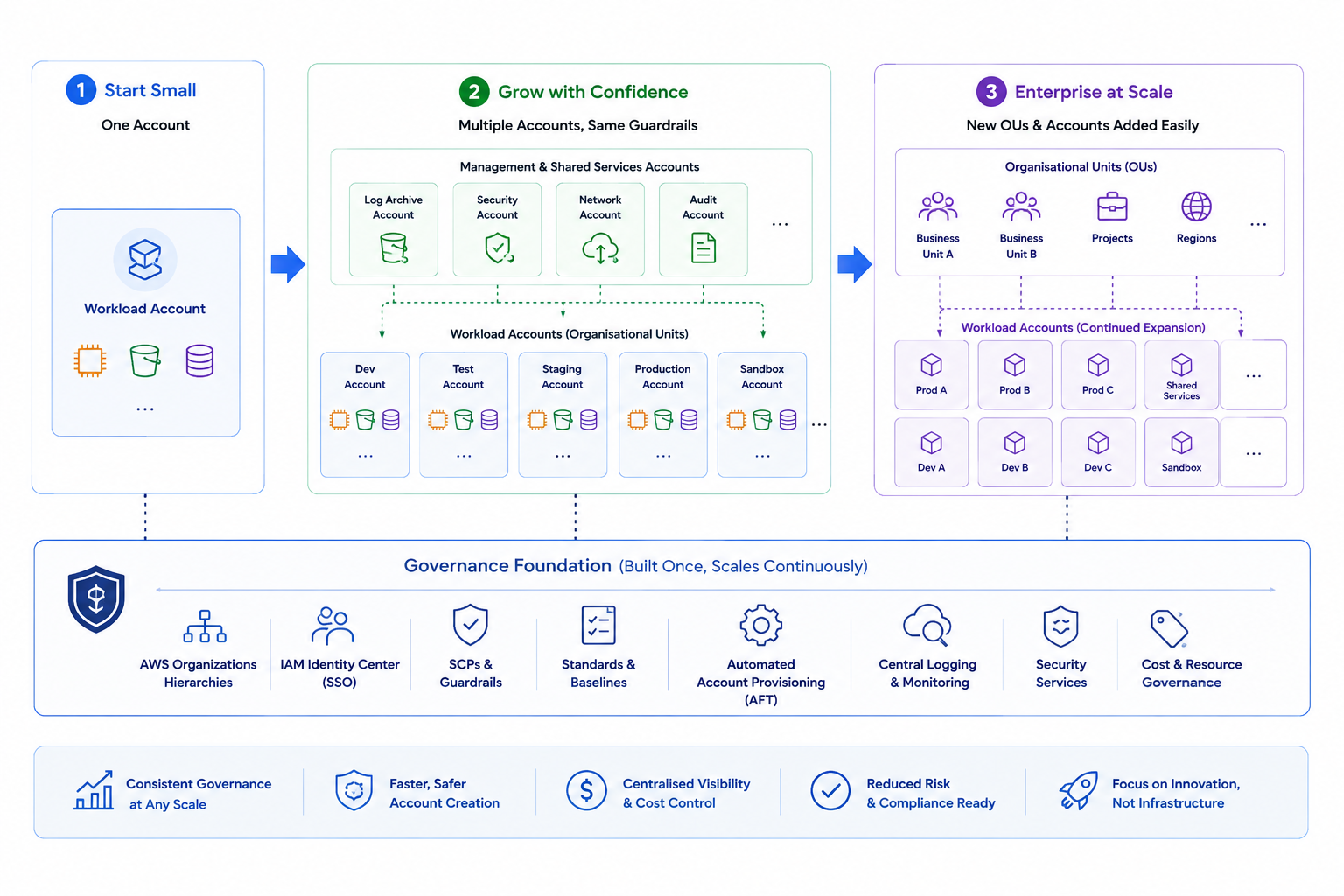
Many organisations begin with one AWS account. As workloads and teams grow, a landing zone introduces clearer account separation, centralised access, consistent controls and stronger visibility across the AWS estate.
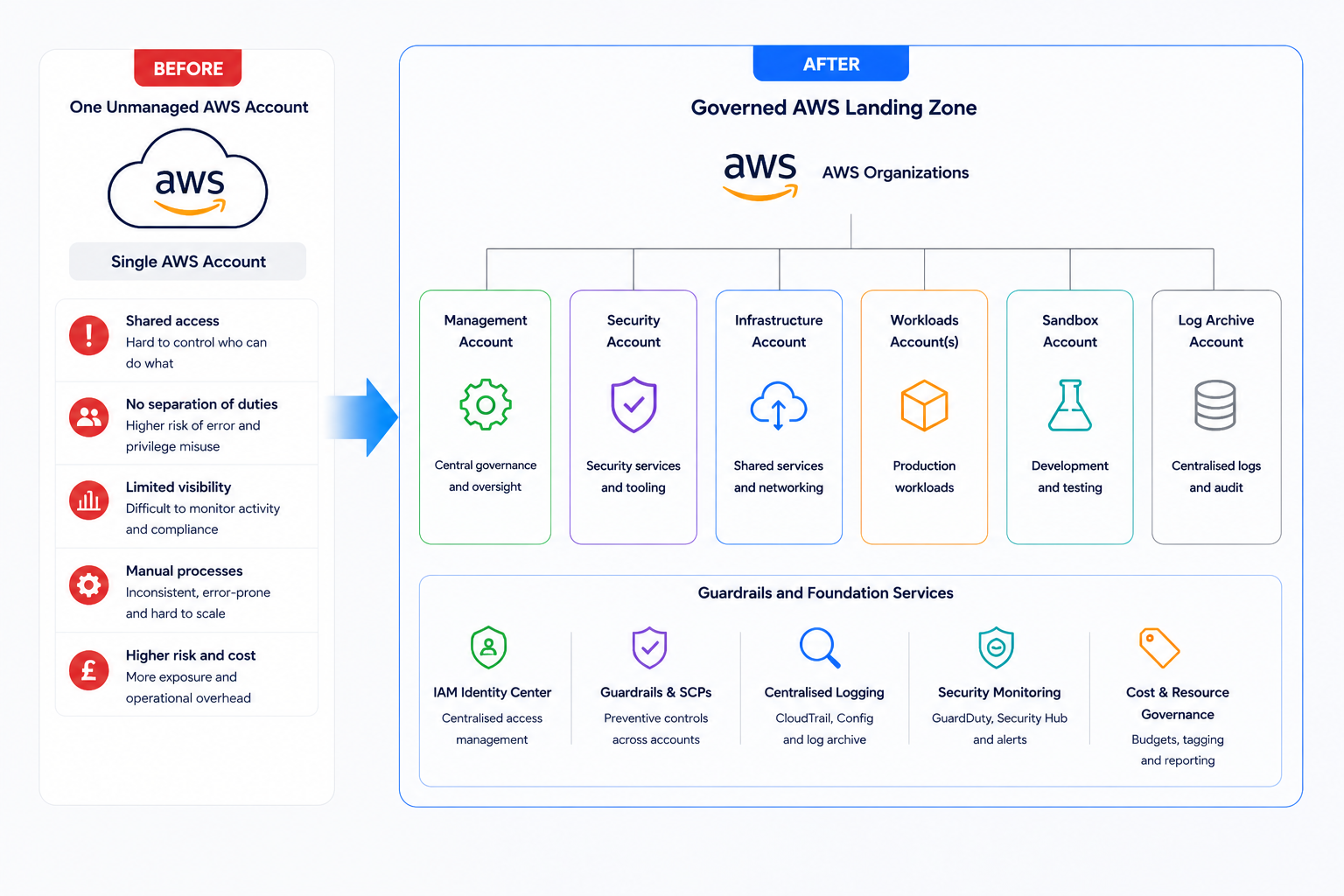
The structure shown is illustrative. The final account model, organisational units and governance controls are aligned to the organisation's workloads, operating model and risk requirements.
As AWS usage grows, governance and operational complexity grow with it
Many organisations begin with a single AWS account and a limited number of users. As more applications, environments and teams are introduced, the absence of a clear operating model can create avoidable security, access, visibility and cost-management risks.
Everything is running in one account
Production, testing, development and administration are mixed together, increasing the impact of mistakes and making ownership less clear.
Permissions have grown without control
Users accumulate broad access over time while responsibilities, approval routes and emergency access procedures remain undocumented.
Logs and findings are fragmented
CloudTrail logs, AWS Config data and security findings are spread across accounts without clear central ownership or review.
New environments are created differently
Each account or workload is configured in a different way, creating inconsistent controls and duplicated operational effort.
Security reviews are difficult to answer
The business struggles to demonstrate who has access, where logs are stored, which controls are active and how changes are governed.
Cloud spend is harder to explain
Inconsistent tags, unclear ownership and decentralised resources make billing, accountability and optimisation more difficult.
A governed operating model for secure cloud growth
An AWS landing zone defines how accounts are organised, how users gain access, where security information is collected, which controls apply and how new environments are introduced. The result is a cloud foundation that is easier to govern, support and expand.
Multi-account architecture
Design an AWS Organizations structure that separates responsibilities and reduces the impact of mistakes, compromised access or uncontrolled changes.
- Management account
- Security and log archive accounts
- Production and non-production accounts
- Shared services and sandbox structures where appropriate
AWS Control Tower foundation
Configure AWS Control Tower as the governed starting point for the multi-account environment.
- Landing zone deployment
- Organisational unit registration
- Account enrolment
- Baseline preventive and detective controls
Identity and access design
Create a central access model using AWS IAM Identity Center, user groups and permission sets.
- Administrator, developer and read-only access
- Billing and security access roles
- Multi-factor authentication expectations
- Emergency access procedures
Central security and logging
Separate audit and security responsibilities from daily workload administration.
- Organisation-wide CloudTrail logging
- Protected log storage
- AWS Config aggregation
- GuardDuty and Security Hub administration
Governance guardrails
Use service control policies and AWS Control Tower controls to define what accounts are permitted to do.
- Restrict unapproved AWS Regions
- Protect important logging and security services
- Reduce risky root-user activity
- Apply agreed account boundaries
Operational and cost foundations
Establish practical baselines that improve day-to-day visibility and accountability.
- Backup policy recommendations
- CloudWatch alarm foundations
- AWS Budgets and billing alerts
- Cost allocation and ownership tagging
AWS-native technology, aligned to business requirements
The service is delivered using AWS-native capabilities such as AWS Organizations, AWS Control Tower, IAM Identity Center, CloudTrail, AWS Config, GuardDuty and Security Hub. These services support the design; the value lies in the operating model, controls and responsibilities established around them.
Need to review an existing AWS setup?
Existing accounts, logs and security services may be reusable. The safest approach is to assess the current environment before deciding what should be enrolled, retained or redesigned.
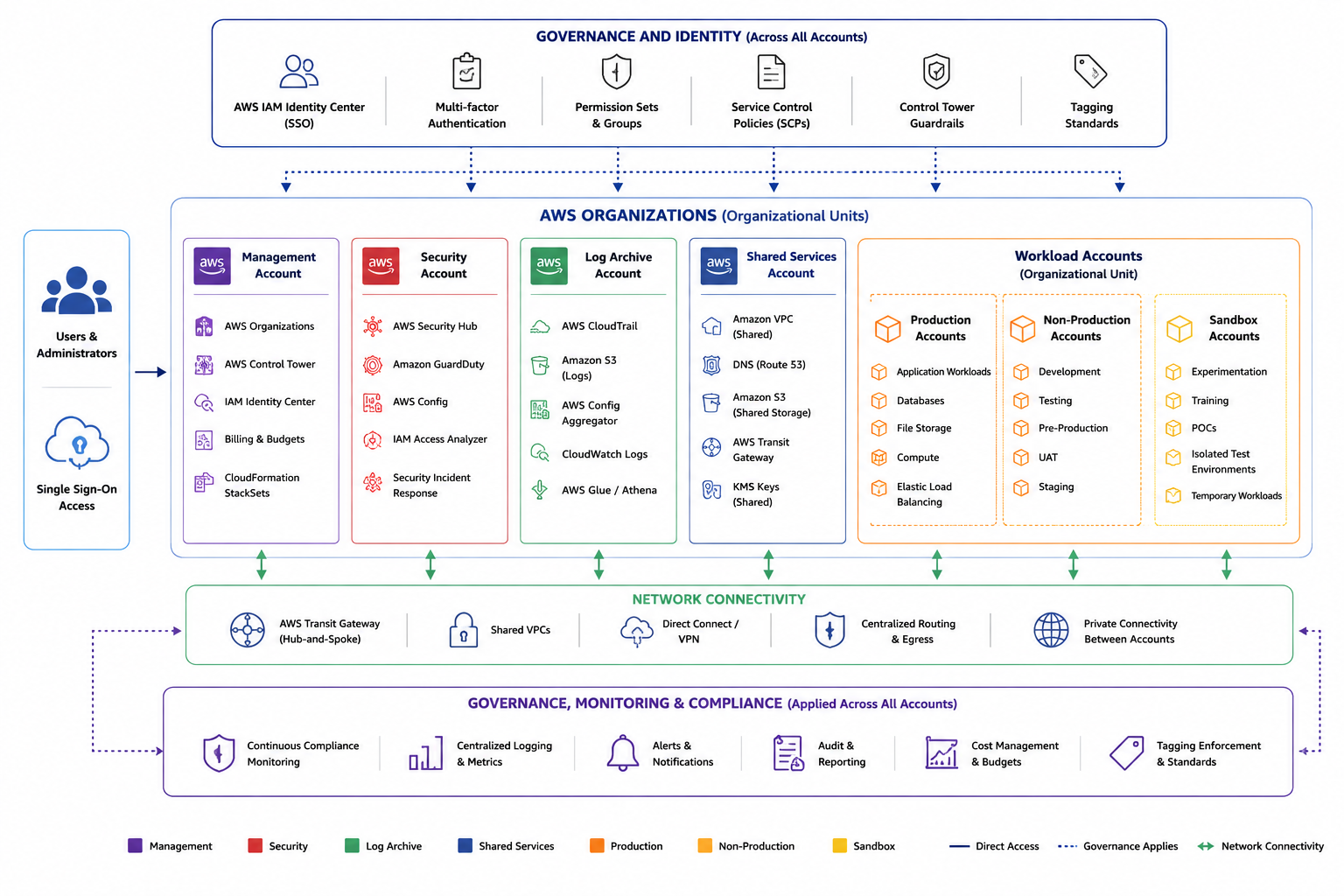
A clear multi-account AWS landing zone
The final account and organisational unit design should reflect the organisation, its workloads, operating model and security requirements. A well-designed landing zone separates management, security, shared services and workload accounts so governance can be applied consistently as the AWS estate grows.
Governance around the account structure
The account model is supported by AWS-native services and documented controls that provide centralised access, audit visibility, policy enforcement and operational oversight.
Account and access governance
- AWS Organizations and AWS Control Tower
- AWS IAM Identity Center
- Service control policies
- Control Tower preventive and detective controls
Security and operational visibility
- AWS CloudTrail and AWS Config
- Amazon GuardDuty and AWS Security Hub
- AWS Backup and CloudWatch foundations
- Budgets, billing alerts and tagging standards
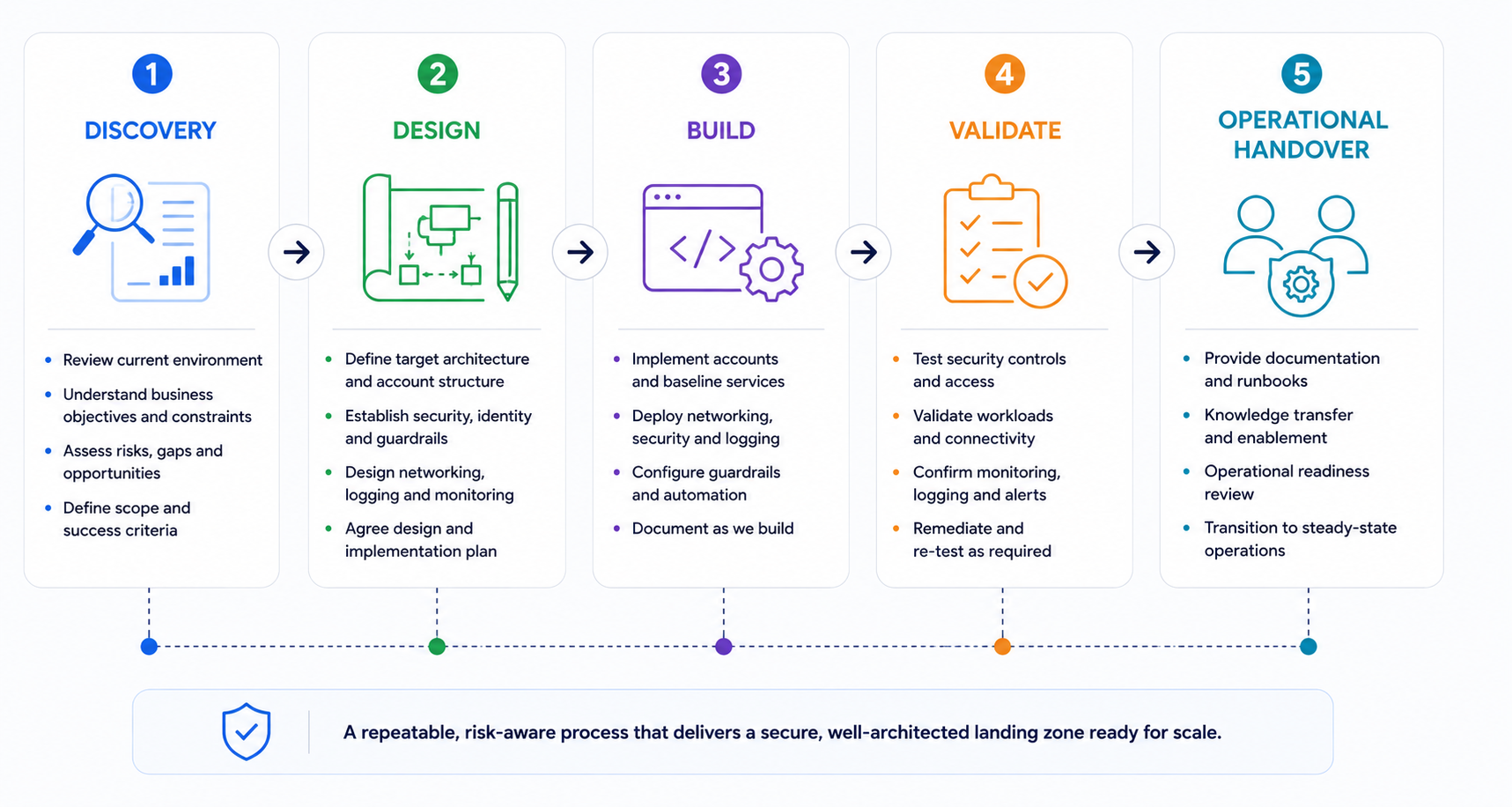
A structured path from discovery to operational handover
Every engagement begins with a review of the current environment, business requirements and operational risks. Design decisions are agreed before implementation, followed by validation, documentation and handover.
Discovery
Review the current AWS estate, workloads, user access, security concerns, business structure and future plans.
Architecture Design
Define the account structure, organisational units, access approach, logging model and baseline control plan.
Foundation Build
Configure the agreed organisation, Control Tower foundation, access model, security services and governance controls.
Validation
Test account access, log collection, security delegation, guardrail behaviour and operational procedures.
Operational Handover
Provide documentation, explain the environment and identify the next priorities for workloads, automation or compliance.
Bring greater control to an environment that is already in use
Establishing a landing zone does not always require rebuilding the AWS estate. Existing accounts, workloads and security services can often be assessed and incorporated into a more structured governance model.
Current-state assessment
- Review the existing AWS Organizations structure
- Assess current CloudTrail and AWS Config services
- Identify unmanaged IAM users and broad permissions
- Map production, development and shared resources
- Review account ownership, billing and tagging
Controlled transition
- Enrol suitable accounts into AWS Control Tower
- Separate central security and logging responsibilities
- Introduce controls gradually
- Document exceptions and compatibility issues
- Reduce disruption to existing applications
What a well-designed AWS landing zone should deliver
The outcome should be a cloud environment that is easier to govern, easier to explain and better prepared for business growth.
Growing SaaS businesses
Separate customer-facing production workloads from development, testing and security administration.
Businesses preparing for migration
Establish the AWS foundation before important applications, databases and data are moved.
Teams outgrowing one AWS account
Reduce access, billing, operational and security problems caused by placing everything together.
Organisations facing security reviews
Improve the ability to explain access, logging, account ownership and active governance controls.
Businesses pursuing compliance
Create technical foundations that can support ISO 27001, Cyber Essentials and internal governance requirements.
Agencies and development teams
Introduce a more repeatable structure for multiple workloads, environments or client-facing systems.
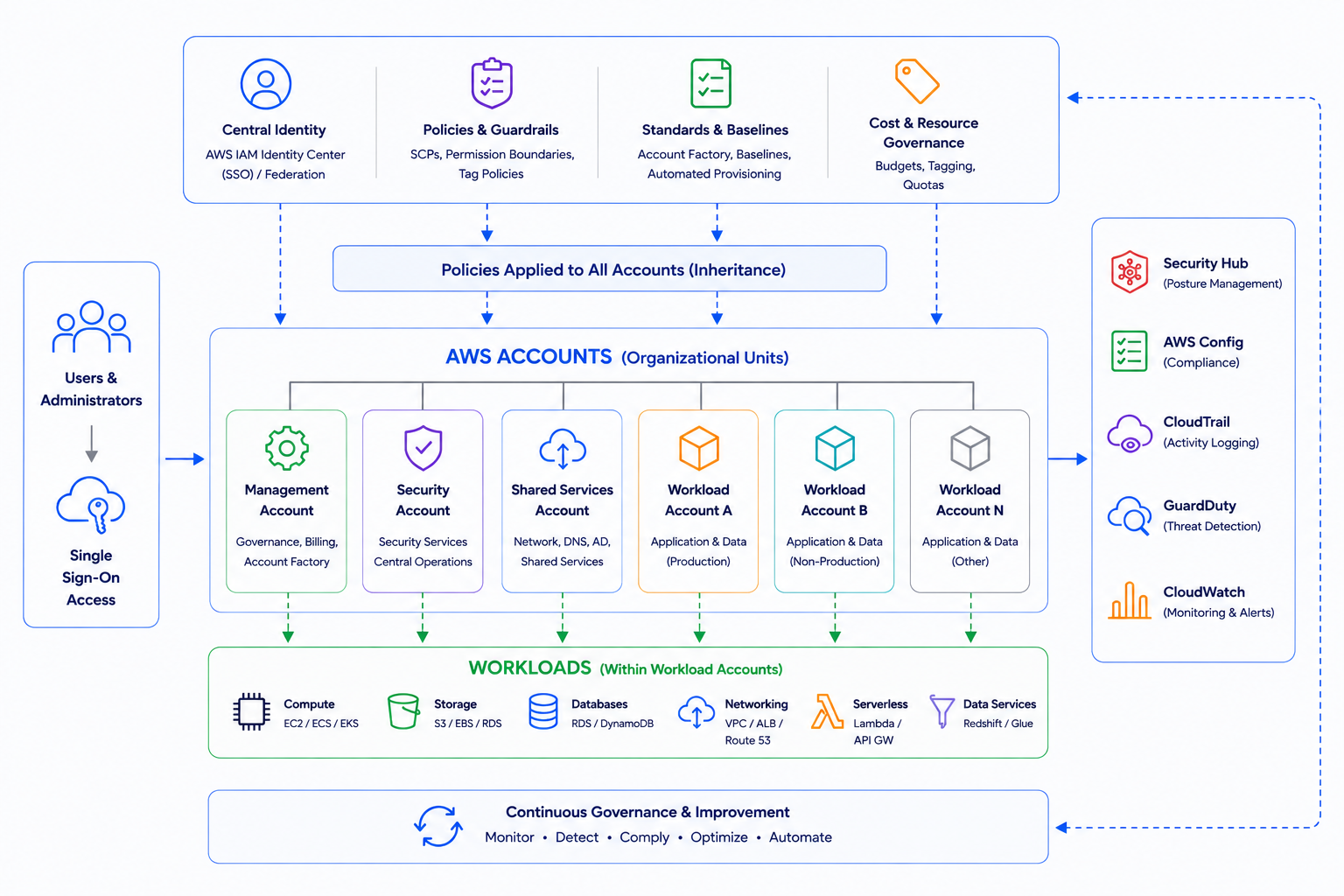
The reference architecture below illustrates how identity, governance controls, security services and workload accounts work together to create a secure, well-managed AWS landing zone. While every implementation is tailored to the organisation, the underlying governance principles remain consistent.
A stronger foundation for governance
A landing zone can provide technical foundations that support stronger access control, auditability and operational discipline.
- Central access and multi-factor authentication
- Separation of duties
- Security logging and investigation
- Configuration monitoring
- Backup governance
- Asset ownership and change control
- Evidence collection for internal or external reviews
Technology alone does not create compliance
An AWS landing zone does not make an organisation automatically compliant or certified. Compliance also depends on policies, risk management, staff responsibilities, documented processes, evidence and ongoing operation.
Where relevant, the technical controls can be considered alongside business requirements connected with ISO 27001 and Cyber Essentials. See our Cloud Security & Compliance service for related support.
Reduce reliance on manual configuration
Where repeatability is required, selected landing zone components can be managed as version-controlled infrastructure. This makes changes easier to review, document and reproduce across environments.
- Repeatable policy and baseline deployment
- Version-controlled governance changes
- Automated account provisioning where justified
- Consistent account configuration and governance standards
- Reusable security, tagging and monitoring foundations
Technology aligned to operational need
Infrastructure as Code tools such as Terraform may be used where they provide clear operational value. The level of automation should reflect the size, rate of change and governance needs of the AWS estate.
Clear technical and operational deliverables
The final scope is agreed during discovery, with deliverables aligned to the size and maturity of the AWS environment.
Architecture and account model
Landing zone architecture, organisational unit design, account responsibilities and workload placement guidance.
Identity and governance baseline
IAM Identity Center structure, permission sets, service control policies and agreed Control Tower controls.
Security and logging configuration
Security administration, central logs, configuration visibility and baseline findings management.
Cost and operational recommendations
Tagging, ownership, budgets, alarms, backup and operational visibility recommendations.
Control and configuration record
A documented record of major decisions, active controls, known exceptions and areas requiring future work.
Administrator handover
Runbook, architecture explanation, administrative procedures and a prioritised next-step plan.
Choose the right starting point
Start with a review, move into a full foundation build or scope a more automated governed platform based on the size and maturity of your AWS environment.
Landing Zone Review
For businesses already using AWS but unsure whether the current structure is secure, governed or ready to scale.
- Current-state review
- Account and access assessment
- Logging and governance review
- Risk summary
- Recommended target structure
- Prioritised action plan
AWS Foundation Build
For businesses creating or restructuring a secure multi-account AWS environment.
- Discovery and landing zone design
- AWS Organizations structure
- AWS Control Tower foundation
- Identity and access baseline
- Central logging and security
- Governance controls
- Documentation and handover
Governed AWS Platform
For organisations that need a more automated, repeatable and compliance-aware AWS foundation.
- Everything in the Foundation Build
- Version-controlled infrastructure
- Advanced governance controls
- Control mapping and assurance support
- Account provisioning automation
- Workload onboarding standards
- Cost and observability baseline
A well-designed AWS landing zone is built once and then scales with your organisation—supporting additional accounts, teams, workloads and governance requirements without needing to redesign the underlying foundation.
AWS landing zone questions
What is an AWS landing zone?
An AWS landing zone is a structured multi-account AWS environment with agreed controls for identity, security, logging, governance and account creation. It provides a foundation on which workloads can be deployed more safely and consistently.
Do small businesses need multiple AWS accounts?
Not every small business does. Multiple accounts often become valuable when a business runs production workloads, has several developers, stores sensitive data or needs clearer separation between security, billing and day-to-day operations.
Is AWS Control Tower the same as a landing zone?
AWS Control Tower is an AWS service used to establish and govern a multi-account environment. A complete landing zone also includes the surrounding architecture, access model, security responsibilities, operational processes, documentation and workload standards.
Can existing AWS accounts be added?
In many cases, yes. Existing accounts can be reviewed for enrolment or inclusion within a new AWS Organizations structure. Compatibility, existing controls and operational risk should be assessed before changes are made.
Will this disrupt existing applications?
The design process aims to minimise disruption. Some governance changes can affect existing resources or deployment processes, so controls should be introduced carefully and tested before wider enforcement.
Does a landing zone make us ISO 27001 compliant?
No single AWS deployment provides ISO 27001 certification. A landing zone can support relevant technical controls, but certification also depends on business policies, risk management, staff processes, evidence and independent assessment.
Can the landing zone be managed with Terraform?
Yes. Terraform can be used to manage many parts of the environment where infrastructure as code is appropriate. The exact implementation depends on the organisation's requirements and the existing AWS setup.
What does an AWS landing zone cost to run?
AWS Control Tower does not have a separate service charge, but the AWS services it enables or uses can generate costs. These may include AWS Config, CloudTrail storage, GuardDuty, Security Hub, CloudWatch, S3 and other security or logging services. The likely operating cost should be considered during design.
Can you also deploy our application?
The landing zone establishes the governed AWS foundation. Application onboarding, networking, databases and workload deployment can be scoped as a separate engagement after the foundation has been agreed.
Create a clearer, more governable AWS environment
Whether you are establishing AWS for the first time or bringing structure to an existing estate, CloudOps Studio can help define the account model, access controls and governance foundation your organisation needs.
No obligation. The first step is to establish whether a landing zone is appropriate for the size, maturity and risk profile of your AWS environment.